Contact US
lf you have any queries, get in touch today! Don't hesitate, We try to take the extra step forour customer satisfaction.

News
Chemical Engineering and Process
What are the different types of grooved rollers in a rubber mixing mill?
Time: 2025-01-06 10:31:44
Author: DALIAN BAOFENG MACHINERY MANUFACTURING COMPANY
Click:
Grooved rollers in a rubber mixing mill can be classified into various types acc
Grooved rollers in a rubber mixing mill can be classified into various types according to different criteria. Here are some common classifications and types:
Classified by groove shape
- Straight-grooved rollers
The grooves are in a straight line and evenly distributed along the axial direction of the roller. This type of grooved roller can provide relatively stable frictional and shearing forces, allowing the rubber compound to be uniformly affected in the axial direction. It is conducive to the preliminary mixing and transportation of the rubber compound and is suitable for the initial processing and rough mixing stages of the rubber compound.

- Spiral-grooved rollers
The grooves are spiral-shaped around the roller surface. When the spiral-grooved roller rotates, it makes the rubber compound move in a spiral trajectory. It can not only provide axial conveying force but also exert shearing and stirring effects on the rubber compound in the circumferential direction, thus enhancing the mixing effect and making the rubber compound mix more evenly. It is often used in the rubber mixing process that requires in-depth mixing and dispersion.

- Herringbone-grooved rollers
The groove shape is similar to a herringbone, consisting of two or more intersecting inclined straight grooves. Herringbone-grooved rollers combine some of the characteristics of straight-grooved rollers and spiral-grooved rollers. They can provide axial conveying force to a certain extent and generate strong shearing and kneading effects at the intersecting grooves, which is beneficial for the local mixing and refinement of the rubber compound. They are often used in situations where higher requirements are placed on the mixing quality of the rubber compound.
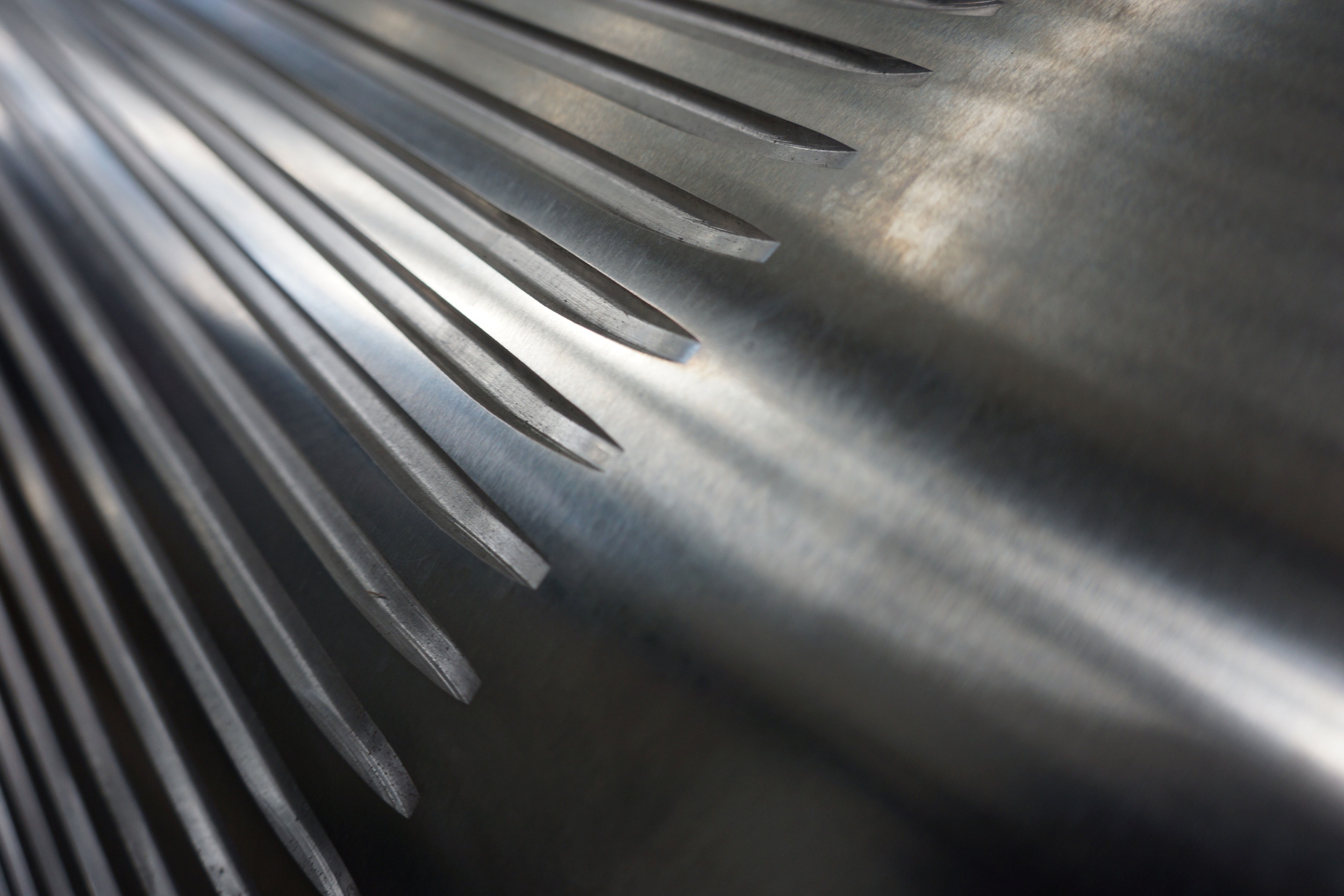
- Crescent-grooved rollers
The grooves are crescent-shaped, usually a series of equally spaced crescent-shaped recesses. When this type of grooved roller comes into contact with the rubber compound, the crescent-shaped grooves can create a unique stress distribution in the rubber compound. While the rubber compound is being squeezed and sheared, local eddies and agitation can also be formed within the crescent-shaped areas, which helps to improve the dispersion and uniformity of the rubber compound. It is especially suitable for situations where higher requirements are placed on the dispersion of additives in the rubber compound.
Classified by groove depth
- Shallow-grooved rollers
The groove depth is relatively shallow, usually within a few millimeters. Shallow-grooved rollers are mainly used for lightly processing and treating the rubber compound. For example, in the early stage of rubber mixing, they are used to guide the flow of the rubber compound, initially increase the friction, and conduct simple mixing. Their shearing and mixing effects on the rubber compound are relatively weak, but they can preliminarily organize and transport the rubber compound without overly damaging its structure.
- Deep-grooved rollers
The groove depth is relatively deep, usually more than 10 millimeters or even deeper. Deep-grooved rollers can generate strong shearing, dividing, and mixing effects on the rubber compound. They are suitable for occasions where the rubber compound needs to be deeply processed and mixed. For example, in the later stage of the rubber mixing process, when various compounding agents need to be fully mixed into the rubber compound and the rubber compound needs to reach a high degree of uniformity and dispersion, deep-grooved rollers can play a better role.
Classified by roller material
- Steel grooved rollers
Made of steel, they have high strength and hardness and can withstand large pressures and frictional forces. They are suitable for handling large amounts of rubber compound and high-intensity rubber mixing operations. Steel grooved rollers have good wear resistance and a long service life, but their thermal conductivity is relatively poor. During the rubber mixing process, additional cooling measures may be required to control the temperature of the rubber compound.
- Cast iron grooved rollers
Manufactured from cast iron, they have good casting performance and wear resistance and can be made into various complex groove shapes. Cast iron grooved rollers have a relatively low cost and certain shock absorption properties, which help to reduce vibration and noise during the rubber mixing process. However, their strength is slightly lower than that of steel rollers, so they may need to be used with caution in some high-load rubber mixing situations.
- Alloy steel grooved rollers
Made of alloy steel, they combine the advantages of multiple alloy elements, having high strength, high wear resistance, good heat resistance, and corrosion resistance. Alloy steel grooved rollers are suitable for special rubber mixing processes with extremely high requirements for rubber compound quality and roller performance. For example, when processing some high-performance rubbers or rubber compounds containing corrosive additives, alloy steel grooved rollers can better meet production requirements, but they have a high cost.
- Rubber-coated grooved rollers
A layer of rubber material is coated on the surface of the metal roller. This type of grooved roller uses the elasticity and flexibility of rubber to provide a gentler acting force when in contact with the rubber compound, reducing damage to the rubber compound. It is especially suitable for handling some rubber compounds that are sensitive to shearing force and friction, such as natural rubber or some special synthetic rubbers. At the same time, the rubber coating can also play a buffering role, reducing noise and vibration during the rubber mixing process.

点击右上角
分享给朋友吧







 Long by picture save/share
0
Stay up to date with our latest news
Subscribe to our newsletter and stay updated on the latest
developments and offers!
Stay up to date with our latest news
Subscribe to our newsletter and stay updated on the latest
developments and offers!
CHEMICAL
点击右上角
分享给朋友吧
Copyright © 2005-2024 DALIAN BAOFENG MACHINERY MANUFACTURING COMPANY. All Rights Reserved.
